This is a braised pork dish which literally means “square simmered" – cubes of pork are simmered for a long time with dashi, soy sauce, mirin, sugar and sake. This is a classic served at izakaya which are local pubs, taverns or the fancy new word - "gastropubs" in Japan.
Although the eating of meat was forbidden in Japan until the Meiji restoration era - one of the recorded historical recipes is very similar to this and that was made from wild boar on occasion. The wild boar are now extinct in Japan, which were hunted by the feudal lords for sport and leisure, and at times desperate and hungry samurai and ronin of the Warring States Era, and its pretty easy to assume that hungry peasants or villagers wouldn't be averse to a little forbidden treat now and again.
Its very versatile - you could add some crushed star anise or some fresh chiles into the braising liquid to add a hint of heat to the pork.
2 lbs. pork belly, or country-style loin ribs cut into cubes
1 piece of kombu seaweed
1 medium sized daikon, grated with liquid, approx 3 cups
1.5 inch piece of ginger, grated
1/4 cup sugar
1/2 cup sake
3 tbsp. mirin
1/4 cup shoyu such as Kikkoman or Yamasa, you could also use tamari.
2 cups dashi stock
Salt
Put piece of kombu in a pot of cold water. Soak the kombu for 30 minutes.
Add pork cubes into the pot of water with kombu and slowly bring to boil over medium/low heat. Once it reaches boil, take the piece of kombu out and discard. Allow the pork to simmer for another 2-3 minutes, then drain the pork and rinse.
Mix the grated daikon and ginger together. In a heatproof dish, place a third of the grated daikon/ginger mixture over the bottom of the dish. Place the pork cubes on top of the grated daikon/ginger and cover with the remaining daikon/ginger.
Place the dish over a steamer and steam for 2-3 hours (replenish the steaming water as necessary). The steaming flavors and tenderizes the pork.
Once the pork can be easily pierced with a skewer, remove the dish from the steamer. Place the pork cubes in a bowl of lukewarm water, gently rinse the pork cubes and let cool.
Refrigerate the pork cubes for a few hours or overnight.
Add sugar, sake, mirin and soy sauce to a large heavy bottomed pot/dutch oven. Add cool, steamed pork cubes and toss the pork around so it gets coated with the sauce, then add in 2 cups of dashi stock and simmer for 2-3 hours, turning the pork occasionally for even flavoring and coloring. The pork pieces should all fit in one layer.
Add a little salt to round off the flavors and simmered for a few more minutes. After all the simmering, the pork should be very tender and be covered with a thick dark glaze (a reduction of the braising liquid). Serve with hot steamed rice.
Monday, March 14, 2016
Oyabun "Boss" Japanese Ribs
Of course ribs aren't a common item in Japan,
but they are here. This is a recipe I have been working on, fiddling
with, adjusting. The basic Japanese cooking philosophy with these is to
braise them, then finish - "nimono" or simmered style. Kakuni or
Japanese braised pork is a common offering in this regard.
Part of the challenge here is if you wanted traditionally slow-smoked ribs, the wood smoke flavor either overpowers the miso and shoyu flavors, or the final product is too strongly flavored, and it is not balanced or entirely complementary flavors.
A fast cooking as with yakitori - and shoyu marinades works because the heat caramelizes the shoyu, slow cooking and smoke can give shoyu and miso a bitter off flavor if you aren't careful. I know because I have conducted many experiments trying different methods. One idea I have thought of trying is to add Sapporo beer to the braising liquid.
At the same time I am aiming for a bold dish. I want it to have traditional flavors, with a certain signature. Something unique. One of the flavors I am wanting to incorporate is "Shichi-mi tōgarashi" or seven-flavor chili pepper. These will be made for this year's spring "hana-kai".
2 racks baby back ribs
1 whole unpeeled bulb garlic, halved horizontally across the mid-section
1 medium onion, coarsely chopped
1 medium carrot, coarsely chopped
1/2 cup tomato puree
1 cup sake
2 tbsp. rice vinegar
1/4 cup soy sauce
3 tbsp. sugar
2 tbsp. red miso
1 tbsp. tobanjan
1 tsp. whole black peppercorns
1 tbsp. sesame seeds, for accent
Shichi-mi tōgarashi, optional
Cut each rack of baby back ribs in half, which will yield 4 portions of 5 to 6 ribs each. To a large stockpot, add the ribs, 6 cups water, garlic, onion, carrot, tomato puree, sake, rice vinegar, soy sauce, sugar, miso, tobanjan, and peppercorns and bring to a boil over high heat. Decrease the heat so the liquid gently simmers. Remove any scum or oil that floats to the surface. Cover the pot and cook until the ribs become tender, about 1 hour.
Remove the ribs from the pot and set aside, reserving the cooking liquid. To make the marinade, bring the cooking liquid to a boil over high heat and boil until it reduces by half and becomes syrupy. Remove from the heat and allow the liquid to come to room temperature. Transfer the liquid to the jar of a blender, cover, and pulse until smooth, about 1 minute. Pass the liquid through a fine-meshed strainer suspended over a large bowl and discard any solids caught in the strainer. Set the marinade aside.
Preheat a grill to hot. Grill the ribs for about 4 minutes, flipping once. Sprinkle with generous amount of Shichi-mi tōgarashi. When the ribs are browned and sizzling, brush the marinade on top. Grill for about 2 more minutes, flipping 2 or 3 times, and brushing on more marinade after each turn. Let the ribs rest for 2 minutes. Garnish with sesame seed and serve.
Part of the challenge here is if you wanted traditionally slow-smoked ribs, the wood smoke flavor either overpowers the miso and shoyu flavors, or the final product is too strongly flavored, and it is not balanced or entirely complementary flavors.
A fast cooking as with yakitori - and shoyu marinades works because the heat caramelizes the shoyu, slow cooking and smoke can give shoyu and miso a bitter off flavor if you aren't careful. I know because I have conducted many experiments trying different methods. One idea I have thought of trying is to add Sapporo beer to the braising liquid.
At the same time I am aiming for a bold dish. I want it to have traditional flavors, with a certain signature. Something unique. One of the flavors I am wanting to incorporate is "Shichi-mi tōgarashi" or seven-flavor chili pepper. These will be made for this year's spring "hana-kai".
2 racks baby back ribs
1 whole unpeeled bulb garlic, halved horizontally across the mid-section
1 medium onion, coarsely chopped
1 medium carrot, coarsely chopped
1/2 cup tomato puree
1 cup sake
2 tbsp. rice vinegar
1/4 cup soy sauce
3 tbsp. sugar
2 tbsp. red miso
1 tbsp. tobanjan
1 tsp. whole black peppercorns
1 tbsp. sesame seeds, for accent
Shichi-mi tōgarashi, optional
Cut each rack of baby back ribs in half, which will yield 4 portions of 5 to 6 ribs each. To a large stockpot, add the ribs, 6 cups water, garlic, onion, carrot, tomato puree, sake, rice vinegar, soy sauce, sugar, miso, tobanjan, and peppercorns and bring to a boil over high heat. Decrease the heat so the liquid gently simmers. Remove any scum or oil that floats to the surface. Cover the pot and cook until the ribs become tender, about 1 hour.
Remove the ribs from the pot and set aside, reserving the cooking liquid. To make the marinade, bring the cooking liquid to a boil over high heat and boil until it reduces by half and becomes syrupy. Remove from the heat and allow the liquid to come to room temperature. Transfer the liquid to the jar of a blender, cover, and pulse until smooth, about 1 minute. Pass the liquid through a fine-meshed strainer suspended over a large bowl and discard any solids caught in the strainer. Set the marinade aside.
Preheat a grill to hot. Grill the ribs for about 4 minutes, flipping once. Sprinkle with generous amount of Shichi-mi tōgarashi. When the ribs are browned and sizzling, brush the marinade on top. Grill for about 2 more minutes, flipping 2 or 3 times, and brushing on more marinade after each turn. Let the ribs rest for 2 minutes. Garnish with sesame seed and serve.
Wednesday, November 19, 2014
Hayashi Raisu - this can be complicated by using a demiglaze, if you have some already prepared, or using a hayashi mix but it is just as good simply made.
You can add, peas, mushrooms..whatever.
1/2 lb beef, sliced
2 onions, sliced
2 tbsp. butter
3 tbsp. flour
2 tbsp. red wine or sake
1-2 tsp. beef stock powder and a little more than a cup of water
1 cup tomato juice or tomato-based vegetable juice OR
5 tbsp. tomato paste+2/3 cup water
1 tbsp. soy sauce
1/2 tbsp. Worcestershire Sauce
Potatoes and carrots, optional
Melt butter in a frypan, and stir-fry beef and onions until beef is browned and onions are tender, adding the other extra butter half-way through.
Sprinkle flour over, quickly stir to coat the beef and stir-fry for a minute longer.
Pour wine or sake onto the beef, let the alcohol evaporate a little, then add all remaining ingredients, stir and simmer 20 min.
Serve with rice on a pasta bowl or plate and sprinkle with Ao-nori, if desired.
You can add, peas, mushrooms..whatever.
1/2 lb beef, sliced
2 onions, sliced
2 tbsp. butter
3 tbsp. flour
2 tbsp. red wine or sake
1-2 tsp. beef stock powder and a little more than a cup of water
1 cup tomato juice or tomato-based vegetable juice OR
5 tbsp. tomato paste+2/3 cup water
1 tbsp. soy sauce
1/2 tbsp. Worcestershire Sauce
Potatoes and carrots, optional
Melt butter in a frypan, and stir-fry beef and onions until beef is browned and onions are tender, adding the other extra butter half-way through.
Sprinkle flour over, quickly stir to coat the beef and stir-fry for a minute longer.
Pour wine or sake onto the beef, let the alcohol evaporate a little, then add all remaining ingredients, stir and simmer 20 min.
Serve with rice on a pasta bowl or plate and sprinkle with Ao-nori, if desired.
Wednesday, October 22, 2014
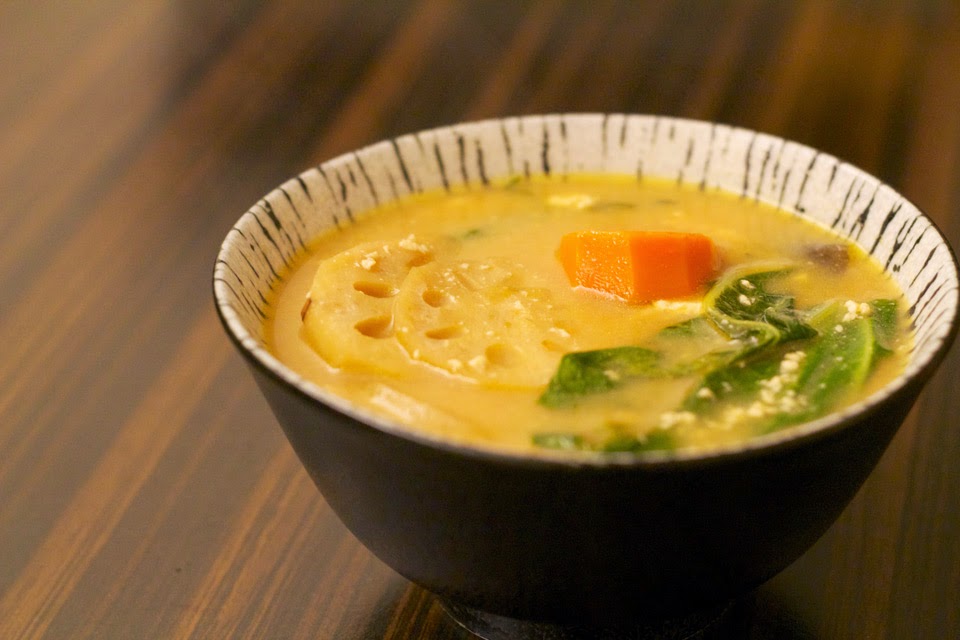
Kenchinjiru - Buddhist Soup
This recipe for vegetable soup comes from Kenchoji-ji TempleThere is a story behind the soup. It would appear that a temple acolyte dropped a block of tofu, shattering it to pieces. Instead of wasting it, he cooked it with some vegetables and the monks seemed to like it.
4-6 dried shiitake mushrooms (fresh are okay too)
5.5 oz gobo or Burdock root
2.5 cups water
10.5 oz daikon, peeled and cut to bite sized wedges.
1 block of konyaku, cut into bite sized pieces
7 oz carrots, peeled and cut into bite sized pieces
3-4 tablespoons sesame oil
3.5 oz lotus root, peeled and cut to bite sized pieces.
2 tablespoons shoyu for sautéing
2.5 cups konbu stock
4 tablespoons saké
1 block firm tofu
4 tablespoons shoyu for soup
2 tablespoons red miso or 3-4 tablespoons white miso, optional but recommended!
Handful of greens - baby spinach, collard greens, etc.
Small amount of ginger juice
Soak the shiitake in the water for 10 minutes. Drain. Soak for another 30 minutes in the 2.5 cups of water. Remove the mushrooms but keep the water as you will use it later. Remove the stalk and cut into bite-sized slices. Peel the gobo and cut into thin bite-sized slices. Soak them in cold water for 5 minutes to remove bitterness. Drain and put aside. Cut the daikon into bite sized pieces and soak in cold water for 10 minutes to remove bitterness.
Cut the konyaku into bite sized pieces and boil for a couple of minutes. Drain and remove.
Heat up the sesame oil in your soup pot (or in a separate pan) and stir fry the gobo, shiitake, konyaku, daikon, carrot, lotus root, and shoyu for around five minutes.
Add the shiitake water, konbu stock, and sake. Bring to a boil. Cook on low heat until vegetables are tender (30-45 minutes). If there’s any froth forming on the top, remove it with a spoon.
Crumble the tofu block into the pot and mix it in. Add the shoyu and miso. Stir gently for a while until you think the miso is dissolved. Add your greens and cook them lightly. Add a small amount of ginger juice to taste.
When you serve this, you can add a little more shoyu to individual bowls as well to taste.
Goes really well with a side of freshly cooked rice.
A lot of ingredients here, but the important thing to know is that you can substitute many of them.
Tampopo Special Ramen
"Lacking neither substance nor profundity".
This is not college dorm ramen. This, is the real deal. The recipe is from the movie Tampopo. If you haven't seen it you should. Very entertaining. I don't want to give spoilers. I have made this broth many times and it is as the old ramen master says in the movie..."Lacking neither substance nor profundity", meaning it is excellent and well balanced.
There is also sort of a "zen" to eating ramen the old master imparts. Most of the ingredients are easy to find, with duck wing and menma being the exception. Chicken wings work just as well, and menma is a bit of an acquired taste.
Broth:
2 pounds of pork bones
2 pounds chicken or duck wings, each bone cut in 2 or so pieces
3 Japanese long onions, a bunch of spring onions or a leek or 2, roughly chopped
Half a head of garlic, each clove cut in half
Konbu
1 Knob ginger, cut in 2-3 pieces
Salt
Enough water to cover all ingredients with a generous clearance
Pork:
3 pounds pork shoulder
1 cup soy sauce
1/2 cup sake
1/2 cup mirin
1 knob ginger, finely sliced
2 cloves garlic
1 bunch green onion, chopped
Other:
Negi (Japanese onion), sliced diagonally
Menma, this is fermented bamboo shoots (available at Asian markets)
Nori
Chuka soba (Chinese-style noodles)
Sesame oil
Soy sauce
Broth:
Place bones in a pot of water, bring to a boil and cook for 1-2 minutes. Drain and discard the water before rinsing bones under a cold tap. Combine bones with other ingredients and bring to a light simmer - never a boil, or the soup will cloud, keeping going, uncovered, for about seven hours. You will probably need to add a little water to keep your 1-2 inch buffer of water above the bones and other ingredients. Once it's done, strain it as much as possible, and either use it, keep it on the low fire for a day of running your ramen shop, or cool and refrigerate or freeze it.
Pork:
Brown the pork all over before simmering it over medium-low heat in a mixture of all the other ingredients for 1.5 hours. Let it cool. For classic ramen chashu, all you have to do is let it cool a bit and thinly slice it (about 4mm).
The braising liquid is great reserved.
Boil some water.
Heat bowls and put a few tablespoons of soy sauce (and a dash of the pork braising liquid if you have it) in the bottom of them.
Dice the pork and quickly stir-fry it with the sliced negi.
Meanwhile put the noodles into the boiling water for about 2 minutes and drain.
Ladle the broth into the bowls, followed by noodles and the negi/pork mixture. Add menma on the side and finish off with a drop of sesame oil over the pork. Done.
For more classic shoyu ramen, combine the soy in the bowls with broth, add noodles, serve with a strip of nori, thinly sliced pork, negi, menma and any other toppings you desire.
This is not college dorm ramen. This, is the real deal. The recipe is from the movie Tampopo. If you haven't seen it you should. Very entertaining. I don't want to give spoilers. I have made this broth many times and it is as the old ramen master says in the movie..."Lacking neither substance nor profundity", meaning it is excellent and well balanced.
There is also sort of a "zen" to eating ramen the old master imparts. Most of the ingredients are easy to find, with duck wing and menma being the exception. Chicken wings work just as well, and menma is a bit of an acquired taste.
Broth:
2 pounds of pork bones
2 pounds chicken or duck wings, each bone cut in 2 or so pieces
3 Japanese long onions, a bunch of spring onions or a leek or 2, roughly chopped
Half a head of garlic, each clove cut in half
Konbu
1 Knob ginger, cut in 2-3 pieces
Salt
Enough water to cover all ingredients with a generous clearance
Pork:
3 pounds pork shoulder
1 cup soy sauce
1/2 cup sake
1/2 cup mirin
1 knob ginger, finely sliced
2 cloves garlic
1 bunch green onion, chopped
Other:
Negi (Japanese onion), sliced diagonally
Menma, this is fermented bamboo shoots (available at Asian markets)
Nori
Chuka soba (Chinese-style noodles)
Sesame oil
Soy sauce
Broth:
Place bones in a pot of water, bring to a boil and cook for 1-2 minutes. Drain and discard the water before rinsing bones under a cold tap. Combine bones with other ingredients and bring to a light simmer - never a boil, or the soup will cloud, keeping going, uncovered, for about seven hours. You will probably need to add a little water to keep your 1-2 inch buffer of water above the bones and other ingredients. Once it's done, strain it as much as possible, and either use it, keep it on the low fire for a day of running your ramen shop, or cool and refrigerate or freeze it.
Pork:
Brown the pork all over before simmering it over medium-low heat in a mixture of all the other ingredients for 1.5 hours. Let it cool. For classic ramen chashu, all you have to do is let it cool a bit and thinly slice it (about 4mm).
The braising liquid is great reserved.
Boil some water.
Heat bowls and put a few tablespoons of soy sauce (and a dash of the pork braising liquid if you have it) in the bottom of them.
Dice the pork and quickly stir-fry it with the sliced negi.
Meanwhile put the noodles into the boiling water for about 2 minutes and drain.
Ladle the broth into the bowls, followed by noodles and the negi/pork mixture. Add menma on the side and finish off with a drop of sesame oil over the pork. Done.
For more classic shoyu ramen, combine the soy in the bowls with broth, add noodles, serve with a strip of nori, thinly sliced pork, negi, menma and any other toppings you desire.
Baked Tonkatsu
A good and lower fat iteration of tonkatsu. You can also use pork chops.
3/4 cup panko breadcrumbs
1 tbsp. olive oil
2 pieces pork loin approximately 1/2 lb
1 tsp. salt
Freshly ground black pepper
2 tbsp. all-purpose flour
1 large egg
Tonkatsu Sauce
1 tbsp. black and/or white sesame seeds
Adjust an oven rack to the middle position and preheat the oven to 400
Combine the panko and oil in a frying pan and toast over medium heat until golden brown. Transfer panko into a shallow dish and allow to cool.
Get rid of the extra fat and make a couple of slits on the connective tissue between the meat and fat to prevent the tonkatsu from curling up.
Pound the meat with a meat pounder, or if you don’t have one then just use the back of knife to pound. Mold the extended meat back into original shape with your hands.
Sprinkle salt and freshly ground black pepper.
Dredge each pork piece in the flour to coat completely and pat off the excess flour. Then dip into the beaten egg and finally coat with the toasted panko. Press on the panko flakes to make sure they adhere to the pork.
Place the pork on the prepared baking sheet. Bake until the pork is no longer pink inside, about 20 minutes.
Cut tonkatsu into 1 inch pieces by pressing the knife directly down instead of moving back and forth. This way the panko will not come off. Transfer to a plate and serve immediately. To make special sesame tonkatsu sauce, grind black and white sesame seeds in a suribachi or mortar and add tonkatsu sauce. Mix all together.
3/4 cup panko breadcrumbs
1 tbsp. olive oil
2 pieces pork loin approximately 1/2 lb
1 tsp. salt
Freshly ground black pepper
2 tbsp. all-purpose flour
1 large egg
Tonkatsu Sauce
1 tbsp. black and/or white sesame seeds
Adjust an oven rack to the middle position and preheat the oven to 400
Combine the panko and oil in a frying pan and toast over medium heat until golden brown. Transfer panko into a shallow dish and allow to cool.
Get rid of the extra fat and make a couple of slits on the connective tissue between the meat and fat to prevent the tonkatsu from curling up.
Pound the meat with a meat pounder, or if you don’t have one then just use the back of knife to pound. Mold the extended meat back into original shape with your hands.
Sprinkle salt and freshly ground black pepper.
Dredge each pork piece in the flour to coat completely and pat off the excess flour. Then dip into the beaten egg and finally coat with the toasted panko. Press on the panko flakes to make sure they adhere to the pork.
Place the pork on the prepared baking sheet. Bake until the pork is no longer pink inside, about 20 minutes.
Cut tonkatsu into 1 inch pieces by pressing the knife directly down instead of moving back and forth. This way the panko will not come off. Transfer to a plate and serve immediately. To make special sesame tonkatsu sauce, grind black and white sesame seeds in a suribachi or mortar and add tonkatsu sauce. Mix all together.
Tuesday, October 21, 2014
Potato Korokke
1 lb potatoes
1 tsp. oil
1/2 lb ground beef
1/2 onion, minced
1/4-1/2 tsp salt
Pepper
Flour/Eggs
Panko bread crumbs)
Oil for deep frying
Bulldog Tonkatsu sauce
Peel potatoes and cut into 4 pieces each. Cook in boiling water until soft. In a big bowl, mash potatoes well. Heat oil in a pan, and start cooking onion. Then add ground beef and cook until browned and cooked through. Season with salt and pepper. Mix potatoes and meat mixture and add some more salt and pepper to taste. Let it cool. Divide potato mixture into 8 pieces and make oval patties. Refrigerate for an hour. Coat with flour, then eggs, and finally Panko bread crumbs. Heat deep frying oil to 350-375, and fry the patties for 3-4 minutes each side.
1 tsp. oil
1/2 lb ground beef
1/2 onion, minced
1/4-1/2 tsp salt
Pepper
Flour/Eggs
Panko bread crumbs)
Oil for deep frying
Bulldog Tonkatsu sauce
Peel potatoes and cut into 4 pieces each. Cook in boiling water until soft. In a big bowl, mash potatoes well. Heat oil in a pan, and start cooking onion. Then add ground beef and cook until browned and cooked through. Season with salt and pepper. Mix potatoes and meat mixture and add some more salt and pepper to taste. Let it cool. Divide potato mixture into 8 pieces and make oval patties. Refrigerate for an hour. Coat with flour, then eggs, and finally Panko bread crumbs. Heat deep frying oil to 350-375, and fry the patties for 3-4 minutes each side.
Showa-era Retro Style - Old Fashioned Japanese Spaghetti Napolitan
Dry spaghetti 4 frankfurters or ham
1 large bell pepper
5-6 button mushrooms
2 tbsp. butter
1 medium onion
Salt and pepper
1/2 cup ketchup
2 tbsp. Bulldog Tonkatsu sauce
Boil the spaghetti while you’re cooking the other ingredients in plenty of salted water. Cook it a minute or two beyond the al dente stage for authenticity. Slice the onion, pepper and mushrooms thinly. Slice the sausages or ham in thin, diagonal slices.
Heat up a wok or large frying pan with the butter or oil or a combination. Incidentally, using lard here would make it closer to the original version. Cook the onion until transclucent, then add the peppers and mushrooms for a few minutes. Add the sausage slices and sauté until lightly browned. Season lightly with salt and pepper. In the meantime, combine the ketchup, Bulldog sauce in a small bowl.
Drain the spaghetti once it’s cooked. Add to the pan. Add the sauce mixture and toss well to combine. Serve immediately, optionally topped with plenty of grated cheese, and/or a dash of Tabasco.
Hiyayakko
1 package (12 oz) silken tofu
1 scallion, finely chopped
1 small thumb size ginger, peeled and grated
Bonito flakes (katsuobushi)
Shoyu
Take tofu out of the package and drain. Cut the tofu in 1/2 or 1/3. Plate the tofu and add some scallions, a little freshly grated ginger and sprinkle some katsuobushi flakes. Pour a little shoyu on and serve.
1 scallion, finely chopped
1 small thumb size ginger, peeled and grated
Bonito flakes (katsuobushi)
Shoyu
Take tofu out of the package and drain. Cut the tofu in 1/2 or 1/3. Plate the tofu and add some scallions, a little freshly grated ginger and sprinkle some katsuobushi flakes. Pour a little shoyu on and serve.
Karaage - Fried Chicken
10 oz. boneless chicken thighs
1 piece fresh ginger
3 tbsp. soy sauce
1 tbsp. sake
About 1/2 cup potato starch (katakuriko) or cornstarch, enough to coat the chicken.
Peanut oil or other vegetable oil
A few drops sesame oil
Cut up the chicken thighs into bite-sized pieces. You can take off the skin if you like, though it does make the chicken crispier. Peel and grate the piece of ginger.
Put the chicken pieces in a bowl. Add the grated ginger, soy sauce and sake, and mix well. Let marinate for a minimum of 10 minutes. Around 30 minutes is ideal. If marinating for more than an hour, use 1 tablespoon soy sauce, then add the other 2 tablespoons just before you're ready to cook them; this prevents the salt in the soy sauce from drawing out too much moisture from the chicken.
Heat the oil, if using a temperature-controlled fryer or a thermometer, aim for 355. If not, a test with a single piece of chicken or a small piece of skin. Toss enough potato or cornstarch into the marinated chicken so it is coated. Fry the chicken pieces a few at a time until a deep golden brown.
Drain well - a wire rack is best for this, but paper towels work too.
Serve with lemon wedges. You can add a sprinkling of grated yuzu peel and/or sansho pepper.
1 piece fresh ginger
3 tbsp. soy sauce
1 tbsp. sake
About 1/2 cup potato starch (katakuriko) or cornstarch, enough to coat the chicken.
Peanut oil or other vegetable oil
A few drops sesame oil
Cut up the chicken thighs into bite-sized pieces. You can take off the skin if you like, though it does make the chicken crispier. Peel and grate the piece of ginger.
Put the chicken pieces in a bowl. Add the grated ginger, soy sauce and sake, and mix well. Let marinate for a minimum of 10 minutes. Around 30 minutes is ideal. If marinating for more than an hour, use 1 tablespoon soy sauce, then add the other 2 tablespoons just before you're ready to cook them; this prevents the salt in the soy sauce from drawing out too much moisture from the chicken.
Heat the oil, if using a temperature-controlled fryer or a thermometer, aim for 355. If not, a test with a single piece of chicken or a small piece of skin. Toss enough potato or cornstarch into the marinated chicken so it is coated. Fry the chicken pieces a few at a time until a deep golden brown.
Drain well - a wire rack is best for this, but paper towels work too.
Serve with lemon wedges. You can add a sprinkling of grated yuzu peel and/or sansho pepper.
Omurice
1 cup cooked white rice
1/2 small onion, finely chopped
1/2 cup chicken breast or boiled ham, cut into small pieces
Butter
Ketchup in a squeeze bottle
2 large eggs
Salt and pepper
Fry the chopped onion until transparent in butter. Add the chicken or ham and cook until done. Add the rice and toss until heated through. Add about 2 tbsps. of ketchup and toss rapidly - you just want to color and flavor the rice, not make it soggy. Season with a little salt and pepper. Mound the rice on a plate in a sort of omelette shape. Start heating a knob of butter in the frying pan until the butter stops bubbling. In the meantime, crack the eggs into a bowl, add a little salt and pepper and whisk with a fork. Pour the egg mixture into the pan and make an omelette that is still slightly runny in the middle. As soon as it's done, carefully turn the omelette onto the mounded rice.
Squirt with a little ketchup on top. Serve immediately.
1/2 small onion, finely chopped
1/2 cup chicken breast or boiled ham, cut into small pieces
Butter
Ketchup in a squeeze bottle
2 large eggs
Salt and pepper
Fry the chopped onion until transparent in butter. Add the chicken or ham and cook until done. Add the rice and toss until heated through. Add about 2 tbsps. of ketchup and toss rapidly - you just want to color and flavor the rice, not make it soggy. Season with a little salt and pepper. Mound the rice on a plate in a sort of omelette shape. Start heating a knob of butter in the frying pan until the butter stops bubbling. In the meantime, crack the eggs into a bowl, add a little salt and pepper and whisk with a fork. Pour the egg mixture into the pan and make an omelette that is still slightly runny in the middle. As soon as it's done, carefully turn the omelette onto the mounded rice.
Squirt with a little ketchup on top. Serve immediately.
Japanese Hamburg Steak - Hambāgu
1 large egg1 small onion finely diced
1 large clove garlic minced
1 lb. ground beef
6 oz. soft tofu - soft
1 cup panko
2 tbsp. ketchup
1 tbsp. oyster sauce
1 tbsp. parsley minced
1 tsp. soy sauce
1/4 tsp. black pepper
1/2 cup dry red wine
1/4 cup ketchup
1/4 cup water
2 tbsp. tonkatsu sauce Worcestershire sauce also works
1 tbsp. demi-glace - optional
Add a tablespoon of vegetable oil to a frying pan and sauté half the onions and all of the garlic until medium brown and caramelized. Let these cool to room temperature.
Combine the beef, tofu, sauteed onions, raw onions, panko, egg, 2 tablespoons of ketchup, oyster sauce, parsley, soy sauce and black pepper in a large bowl. Vigorously knead the mixture together until it is uniform in color and texture. Add more oil to the frying pan that you fried the onions in and place over medium heat. Because the patties are on the soft side, you'll want to form them and add them directly to the pan. Make about 8 oval patties about 1" thick.
Fry them until they've formed a dark brown crust on one side, then use a spatula to carefully flip them over and brown the other side. Unless you have a very large pan, you won't be able to do them all at once, so fry 4 at a time and transfer them to a plate when they're browned on both sides. Don't worry if they're not cooked all the way through as they will finish cooking in the sauce.
After you've fried all the patties, drain off any excess oil but don't wash the pan as the brown stuff is what will give your sauce flavor. Add the red wine and boil until it's reduced by about half in volume.
Add the ketchup, water, tonkatsu sauce, and demi-glace and stir to combine.
Place the patties back into the pan, cover, and cook for 7 minutes, flipping them over once in the middle. Cook uncovered for another 3 minutes to thicken the sauce a little. Serve with rice.
Onigiri
4 cups of freshly cooked Japanese-style rice2 sheets of nori seaweed, cut into 2 inch wide strips
Salt
Traditional fillings:
Pickled plum (umeboshi), bonito flakes just moistened with soy sauce (okaka), bonito flakes mixed with pickled plum (umekaka), flaked cooked salted salmon (shiozake), cooked salty cod roe (tarako), chopped up pickles (tsukemono), and tsukudani, various tidbits - bonito cubes, tiny clams, etc. - cooked and preserved in a strong soy-sugar-sauce.
Some non-traditional fillings:
Ground meat (pork or beef or a mixture), cooked with grated or chopped ginger, then flavored with soy sauce, some red pepper flakes, sake or mirin, and sugar. It should be quite dry. Curry flavored ground meat mixture works surprisingly well too.
Canned tuna, well drained and flaked, flavored with a bit of soy sauce and/or salt to taste.
Chopped up western style pickles.
The key to making good onigiri is to have freshly cooked, hot rice.
Wet your hands with cold water, and sprinkle them with salt. Take 1/4th of the rice and place on one hand. Make a dent in the middle of the rice with your other hand. Put in about 1 tsp or so worth of filling in the dent. Working rapidly, wrap the rice around the filling, and form into a ball. To make the traditional triangular shape, cup your hand sharply to form each corner, and keep turning it until you are satisfied with its shape.
Wrap the rice ball with 1-2 strips of nori seaweed. Repeat for the rest of the rice.
Red Pepper Kinpira
Kinpira refers to a style of cooking that means to saute and simmer. The method lends itself to most any sort of any crunchy or starchy vegetable. It is a very popular okazu or side dish served along with rice.
2 red bell peppers
1 tablespoon sesame oil
1 tablespoon sugar
1 tablespoon soy sauce
1/4 teaspoon red pepper flakes (or to taste)
Mix the sugar, soy sauce and red pepper flakes in a small bowl and set aside.
Remove the top and bottom of the pepper, then cut down the side to open the pepper and remove the seeds. If your pepper is particularly long, cut it in sections so each section is about 1 inch long.
Cut each section into matchstick strips, about 1/4 an inch wide or smaller.
Once your pepper has been cut, place a skillet over medium high heat. Add the oil and wait until the pan is hot. Add the red pepper to the pan and stir to coat in the oil. Saute for about 5 minutes until the pepper has just softened, stirring occasionally. Once the pepper has softened, add the soy sauce mixture and stir constantly until the moisture has dissolved. Once the moisture has dissolved, serve immediately or let cool and serve at room temperature.
2 red bell peppers
1 tablespoon sesame oil
1 tablespoon sugar
1 tablespoon soy sauce
1/4 teaspoon red pepper flakes (or to taste)
Mix the sugar, soy sauce and red pepper flakes in a small bowl and set aside.
Remove the top and bottom of the pepper, then cut down the side to open the pepper and remove the seeds. If your pepper is particularly long, cut it in sections so each section is about 1 inch long.
Cut each section into matchstick strips, about 1/4 an inch wide or smaller.
Once your pepper has been cut, place a skillet over medium high heat. Add the oil and wait until the pan is hot. Add the red pepper to the pan and stir to coat in the oil. Saute for about 5 minutes until the pepper has just softened, stirring occasionally. Once the pepper has softened, add the soy sauce mixture and stir constantly until the moisture has dissolved. Once the moisture has dissolved, serve immediately or let cool and serve at room temperature.
Miso Chicken - Tori Misoyaki
Cooking with miso. To test miso for salt flavor taste test it.For every 1 medium to large chicken thigh or 2 small chicken thighs use the following:
1 tbsp. shiro miso - a mild white miso
1 tbsp. sake or even beer
1/3 to 1/2 tsp. brown sugar
You can use skinned or unskinned chicken here. Cut the meat into bite-size pieces. Mix the marinating ingredients,
Panfry or grill over medium heat for about 5-6 minutes on each side, ot until the chicken is cooked through and the miso is darkly caramelized. It can also be baked.
and spread over the meat. Wrap tightly and let marinate in the refrigerator overnight. If you don’t have time for this, let it marinate at least 10-15 minutes, and massag the meat a bit with your hands to help the flavors permeate. To cook, heat up a non-stick frying pan or a cast iron grill, brush with a little cooking oil to prevent sticking.
Subscribe to:
Posts (Atom)